
Mole Tunnel Math: How Much Damage Is Really Happening Under Your Lawn?
At Northwest Mole Pros, we know the molehills you see on the surface are only part of the story. The real damage happens underground, where moles displace huge amounts of soil while building their tunnel systems. Once you understand how much dirt a mole moves, you’ll see just how serious a mole infestation can be.
Why Molehills Appear: The Basics of “Moleology”
Most homeowners first discover moles when mysterious dirt mounds pop up in the yard. Those mounds reveal two fundamental truths:
- Moleology Law 1: Moles dig tunnels to find food and survive.
- Moleology Law 2: Moles push the displaced soil to the surface, creating molehills.
From here, homeowners usually fall into one of two camps:
- Camp #1: “How do I stop these things from destroying my yard?”
- Camp #2: “They’re part of nature — I’ll just repair the damage.”
But both groups share the same question:
How big is the underground tunnel system causing all this mess?
Let’s break it down.
How Extensive Is a Mole Tunnel System?
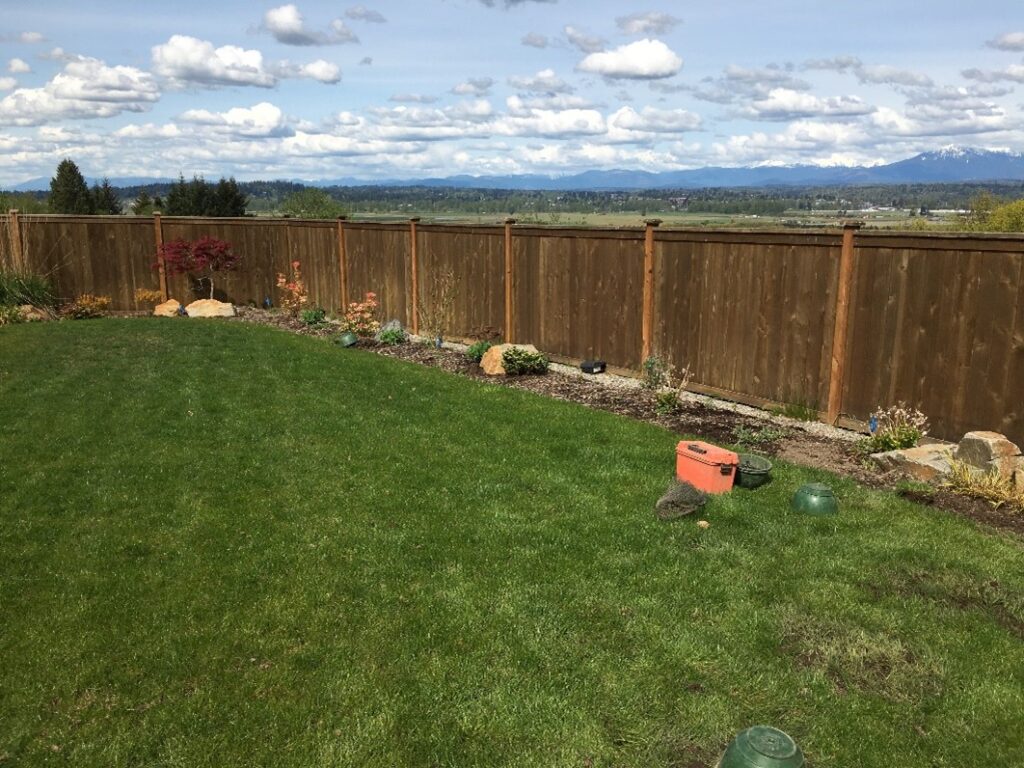
The photo below shows the backyard lawn area of a property with recent mole activity. The lawn is approximately 15 feet wide and 50 feet long with a total area of approximately 750 square feet.
There were several mole mounds, mostly at one end of the lawn. Dirt from the mounds was removed and piled in a nearby bed. The photo below shows the dirt pile which was approximately 4 feet long, 3 feet wide, and 1.5 feet high. For reference, the green flower pot in the lower lefthand corner has a 10-inch diameter.
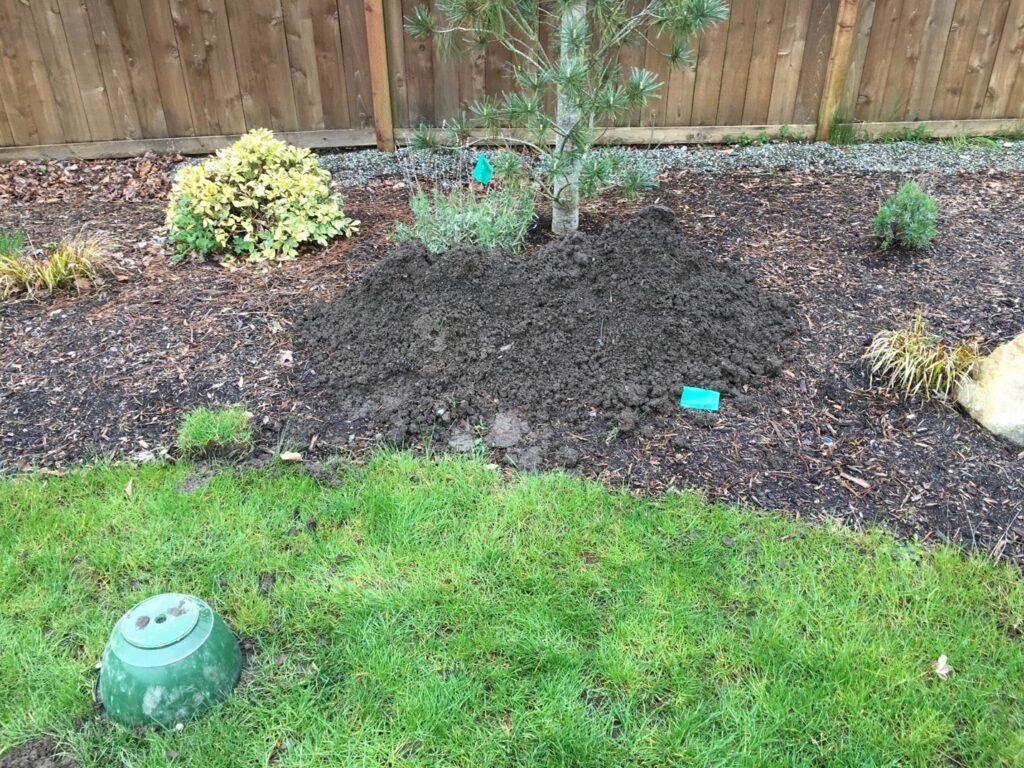
To approximate the volume of the dirt pile, we used a truncated cone to represent the two (2) rounded ends of the pile and a trapezoidal prism for the center portion of the pile with the keys dimensions noted in table 1 below.

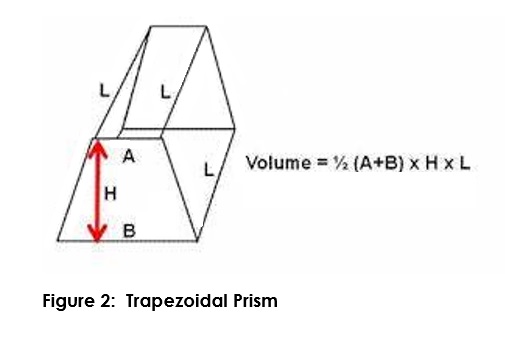
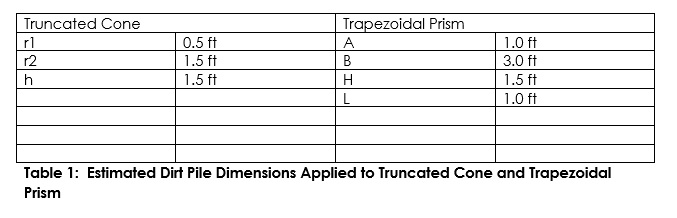
Using the dimensions from table 1, the truncated cone has a volume of 5.1 cu. ft. and the trapezoidal prism has a volume of 3.0 cu.ft. for a total of 8.1 cu. ft.
Based on personal observations, most mole tunnels are 1.5 inches to 2.0 inches in diameter. Table 2 below shows the results if we run these diameters through a pipe volume calculator using our estimated 8.1 cu. ft. dirt pile volume.
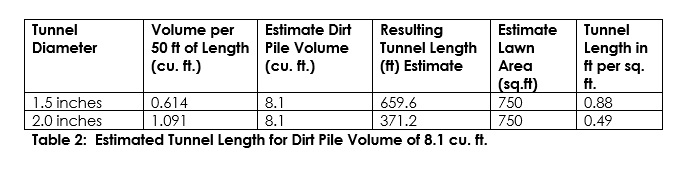
It is clear from Table 2, that tunnel diameter has a significant impact on estimated tunnel length causing it to range from 371 feet to almost 660 feet for a relatively small half-inch change in tunnel diameter. In spite of this fact, we now have a range of tunnel length – a high of 660 and a low of 371. Applying that to the estimated lawn area of 750 sq. ft. results in a high of 0.88 feet of tunnel per square foot to a low of 0.49 feet of tunnel per square foot.
Conclusion
We know that moles do not tunnel uniformly in a lawn, but we now have a comparative estimate for the tunnel density. Yes, 6-10 inches of tunnel per square foot of lawn.
NW Mole Pros Makes Mole Tunnel Math Easy!
Right now, you may be saying “I was told there would be no math…” Well, no problem! Northwest Mole Pros is happy to take the calculations off your hands and get to work solving your mole problem. Just contact us by phone at (425) 368-3700, or by email at customercare@nwmole.com.